

You’ve revised the witches and King James I. You know the Victorians cared about reputation. You can tell me when Lord of the Flies was published. Super! But when it comes to putting historical context into a GCSE English essay, all too often, it appears as an add-on section at the bottom of a pragraph.
I’ve written context guides for Jekyll and Hyde, Macbeth and Lord of the Flies (to name a few!), without giving this question the attention it deserves: how do you actually use context in GCSE English Literature?
The short answer is to connect a relevant detail about the world of a text to a particular choice the writer makes, then explain how that connection changes your interpretation. Context should help you read more closely. It isn’t a little parcel of historical facts to leave at the end of every paragraph.
What is context in English Literature?
Context is the surrounding world that helps us understand a text: the circumstances in which it was written, the world it depicts, and the ideas, beliefs or literary traditions it draws upon. In GCSE English essays, context is useful when you explain its relationship to the words on the page.
For AQA, Edexcel and OCR, context falls under Assessment Objective 3 (AO3). Each exam board uses the same core wording: students should show an “understanding of the relationship between texts and the contexts in which they were written”. AQA’s specification, Edexcel’s specification and OCR’s specification all set this out.
The exam boards assess AO3 in different questions, though, so check the requirements of your paper before assuming every response needs the same treatment. Some GCSE essays will need context. Others don’t need any at all (phew!).
In an essay, though, ‘context’ means more than mentioning a historical event. It means making an argument about how that event, belief or convention helps explain what the writer is doing.
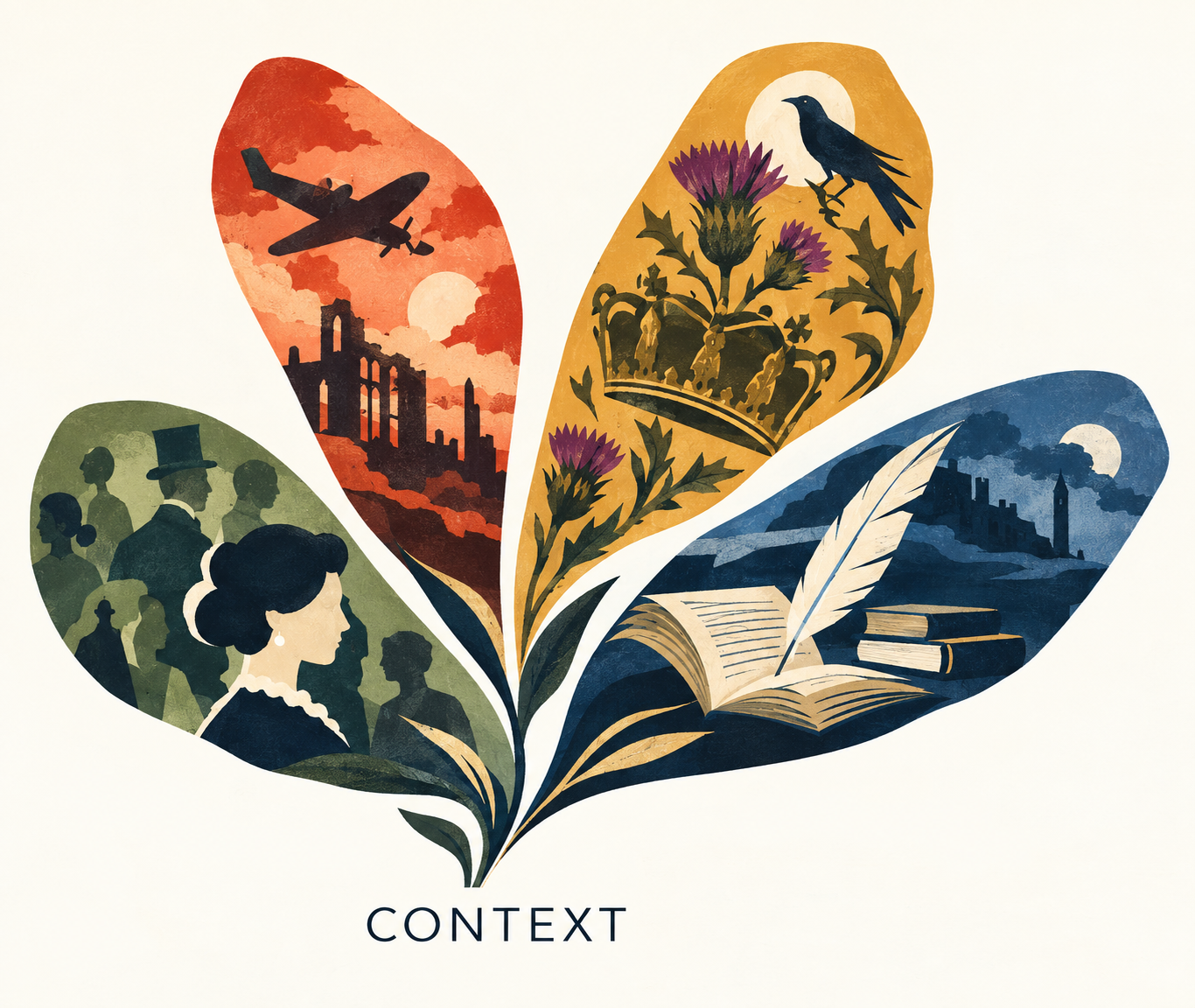
What are the four types of context?
A useful way to organise context is into four broad types: historical, social, cultural and literary. They overlap, and no examiner expects you to label them neatly in your answer.
| Type | What it might include | Example |
|---|---|---|
| Historical | Events, political conditions and changes over time | The Second World War and its aftermath in Lord of the Flies |
| Social | Class, gender, power, family roles and everyday expectations | The importance of respectability in Jekyll and Hyde |
| Cultural | Shared beliefs, religion, fears and values | Ideas about kingship and the supernatural in Macbeth |
| Literary | Genre, conventions and other texts a writer responds to | Gothic conventions in Jekyll and Hyde; adventure fiction in Lord of the Flies |
The writer’s life can also matter, but it isn’t a fifth box you have to tick. A biographical detail earns its place only when it helps you interpret the text.
So, how can you ensure you’re using context to deepen your GCSE English analysis rather than just an add-on? Here are eight key strategies.
1. Start with the question, not the fact you’ve memorised
Choose context that helps you answer the actual question. If you’re writing about ambition in Macbeth, James I’s interest in witchcraft might be relevant when analysing the witches’ influence. If you’re analysing Macbeth’s murder of Duncan, beliefs about kingship and the natural order may take you further.
This sounds obvious until you’re in an exam and a carefully memorised fact is pleading to be included. Ask yourself: What does this detail help me explain about this moment? If the answer is ‘nothing in particular’, save it for another question.
The best contextual point is often quite small. One accurate idea, followed through, is all you need. Here’s what that looks like..
2. Make the link visible: text, context, interpretation
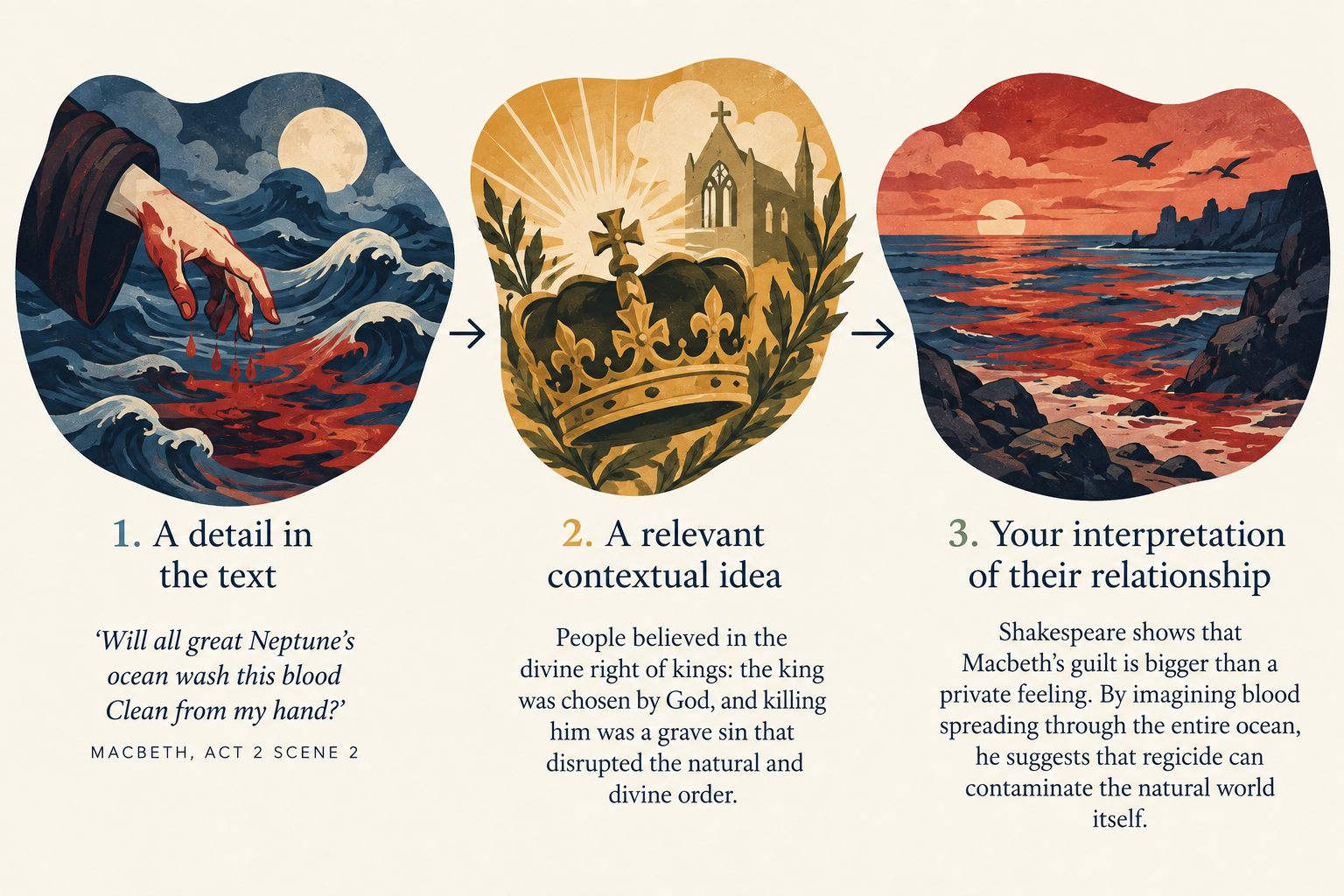
To analyse context, connect three things: a detail in the text, a relevant contextual idea and your interpretation of their relationship. Don’t make the examiner supply the missing link for you.
Suppose the question asks how Shakespeare presents Macbeth’s guilt.
- You could begin with Macbeth’s fear that his bloody hand might make even the ‘great Neptune’s ocean’ turn red.
- Then bring in the belief that killing a rightful king violated an order sanctioned by God.
- Finally, explain what this adds: Macbeth’s horror becomes more than a private guilty feeling. The image makes his act seem capable of contaminating the natural world.
That last move is where the analysis happens. ‘People believed in the divine right of kings’ is information. Explaining why Shakespeare imagines blood spreading through an entire ocean is interpretation.
For the technical version, AQA’s mark scheme looks for “convincing” and “detailed” links between context, text and task. For Grade 8 and 9, they ask for: “Convincing exploration of themes/ideas/perspectives/contextual factors/interpretations.”
So, what does “convincing” and precise look like in practice?
3. Look at what context does to a character
Context can explain the pressure a character faces, the choices available to them and the force of their response. This is more interesting than a paragraph about what people ‘back then’ supposedly thought.
Think of Jekyll’s confession that he ‘concealed [his] pleasures’. A quick answer says that Victorian society valued respectability. A stronger answer asks why a respected doctor feels compelled to divide his public identity from his private desires. Stevenson makes concealment central to both Jekyll’s character and the novel’s terrible experiment. Society’s insistence on appearances is part of the problem the story exposes.
Or think about Sheila Birling in An Inspector Calls. Her privileged position makes her willingness to admit responsibility more striking beside her parents’ refusal. The social setting gives her change weight: she’s challenging the habits of the family that’s protected her, upending gender and generational norms at the same time. This is the approach in OCR’s guide to exploring context, which encourages students to notice how characters conform to or resist the world around them.
Try asking: What does this character stand to lose by acting this way? What would someone in their position be expected to do? Now context is helping you read character, not interrupting your analysis of it.
4. Remember that the date of the story and the date of writing can differ
Separate the world a text portrays from the world in which its writer created it. Sometimes the gap is one of your strongest analytical tools.
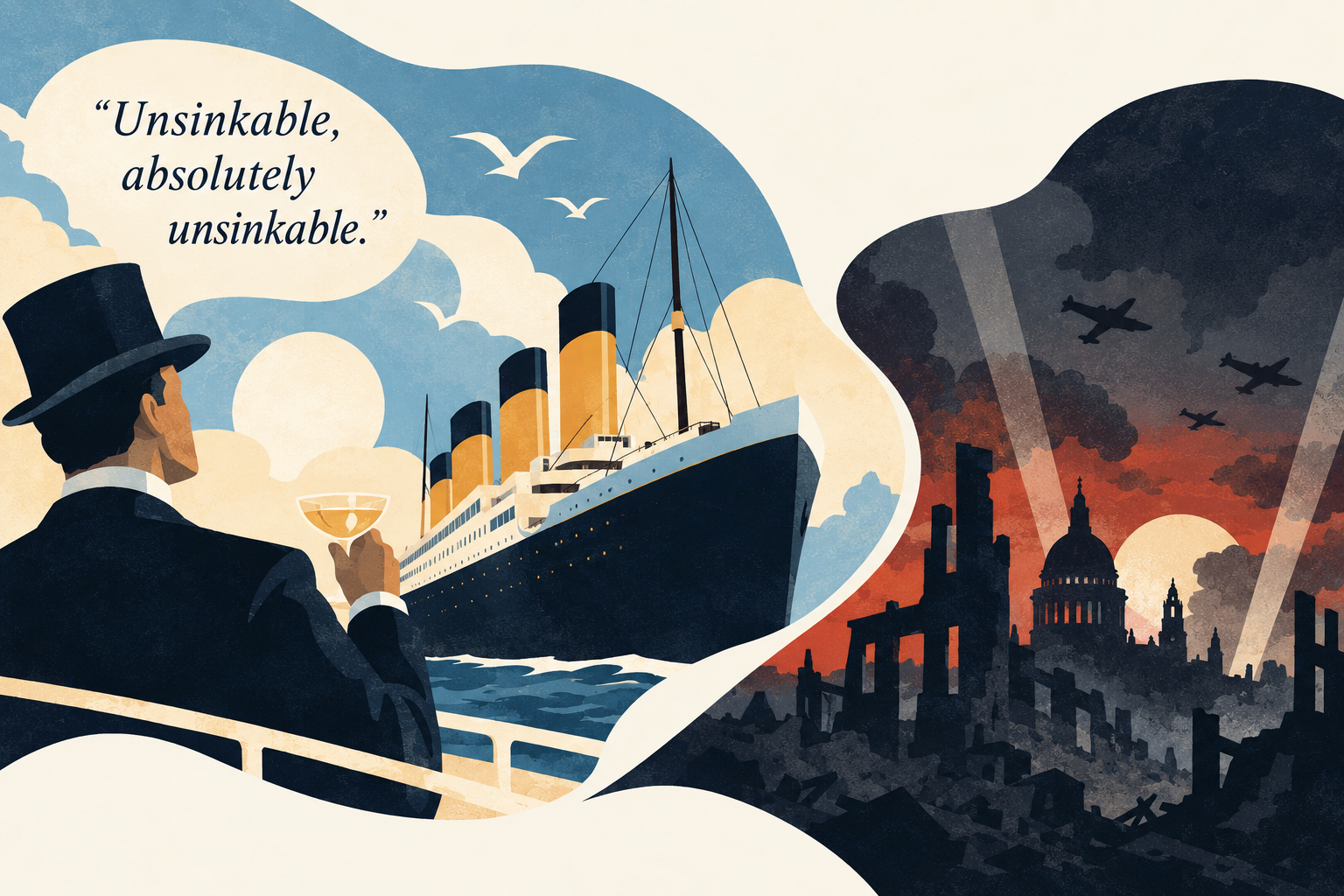
An Inspector Calls is set in 1912 but was first performed in 1945. The Birlings’ confidence about the future belongs to a world before two world wars. Priestley’s audience knew how much of that confidence was misplaced. If you are analysing Mr Birling’s authority, this contrast helps explain why his grand predictions undermine him. The date alone won’t make the point; the dramatic irony will.
The same question can sharpen your reading of other texts: When is this story set? When was it written? What might the difference allow the writer to show? You won’t always need both dates, but you should know which world you’re talking about.
5. Use literary context when it illuminates the writing
Literary context means the genres, conventions and earlier stories a writer uses or challenges. It can be as productive as a political date, especially when the question invites analysis of form or structure.
Jekyll and Hyde draws on the Gothic: secrecy, disturbing transformations and the suggestion that something familiar might conceal something frightening. Calling the book ‘Gothic’ is a start. Showing how Stevenson uses delayed revelation to make even respectable narrators seem unsure of what they know is analysis.
In Lord of the Flies, Golding takes the familiar adventure premise of schoolboys stranded on an island. This is how Chapter 1 starts, but as the book moves on, events become increasingly horrifying. Set that against optimistic stories in which British boys bring “order” to unfamiliar places (Colonialism anyone?), and Ralph’s insistence that ‘we’re not savages’ becomes tragically ironic. Golding tests the assumption beneath the claims.
My Lord of the Flies context guide explores that literary conversation alongside the novel’s post-war setting.
You don’t need an obscure reference to sound sophisticated. A well-explained genre convention can be the more perceptive choice.
6. Be precise about audiences and cautious about sweeping claims
Say which readers or audiences you mean, and avoid claiming that everyone in an era believed the same thing. ‘Victorians were terrified of science’ is too broad, and it flattens a period full of argument, curiosity and scientific excitement.
Compare these two sentences:
- Victorian readers feared science, so Stevenson shows Jekyll’s experiment going wrong.
- For some late Victorian readers, Jekyll’s experiment might have touched anxieties about scientific enquiry crossing moral boundaries; Stevenson complicates that fear by making the experiment inseparable from Jekyll’s desire to protect his reputation.
The second offers a possible reading and stays close to Jekyll. ‘Might have’ is useful here because you cannot speak for every reader. It isn’t a sign of weak thinking.
Be careful with the writer’s intentions, too. ‘Shakespeare wanted every Jacobean audience member to fear witches’ is an enormous claim. ‘Shakespeare presents the witches as unsettling figures in a culture where ideas about the supernatural carried particular force’ gives you a sounder basis for discussing the scene.

7. Weave context into the sentence you’re already writing
Introduce context through the point you are making about the text. You don’t need a special introductory phrase or a separate AO3 paragraph.
For exactly how to add context to a sentence, try one of these sentence structures:
- ‘For a Jacobean audience familiar with ideas about rightful kingship, Macbeth’s attack on Duncan could seem like an offence against the wider order of the world.’
- The structure goes: Audience + beliefs > event > interpretation
- ‘Stevenson’s emphasis on Jekyll’s public standing makes his secrecy especially troubling in a society that prized respectable appearances.’
- The structure goes: Author + focus > event > interpretation
- ‘Written after the Second World War, Golding’s portrait of the boys’ violence challenges easy confidence in human progress.’
- The structure goes: Point in time > author’s choice > interpretation
These are starting points, not spells. Each still needs textual evidence and explanation around it. Notice, too, that none begins with the traditional ‘In those days… / In the Elizabethan era’, an opening that has been asked to carry rather more context than it can reasonably manage!
So, how do you introduce context in an essay? Often you simply let it enter the first paragraph where it helps. In an introduction, one relevant sentence can establish your argument: ‘By setting the Birlings’ certainty in 1912, Priestley allows a later audience to hear how wrong they are.’ You can then develop that idea through the moments you analyse.
Essentially, introduce context where it’s helpful to the point you’re making. If it feels like an add on, maybe wait a bit…
8. Aim for a sharper reading, not a quota of contextual facts
Grade 9 English Literature work uses context to develop an insightful interpretation of the question and the text. It’s not awarded for fitting in the greatest number of facts. An essay also needs a convincing argument, close attention to the writer’s methods and well-chosen evidence. Context helps those things work together.

Take Lord of the Flies. Saying that Golding served in the Second World War tells us something about the writer. Linking the novel’s dead parachutist to the adult war beyond the island takes us further. The boys imagine a beast has come from outside, but what has actually arrived is evidence of human violence. That distinction helps you explain Golding’s larger argument about fear and evil.
This is what I mean by a ‘Grade 9 point’: a specific observation that makes the passage more complicated or revealing. It doesn’t have to be a startling theory nobody else has considered. Sometimes it means noticing an uncomfortable irony and explaining it clearly.
Is it hard to get a 9 in GCSE English Literature? Yes, it’s the highest grade, and strong context alone will not secure it. But you don’t need to write like a university lecturer or know everything about the period. You need to build a thoughtful response to the question, support it with the text and make your contextual knowledge earn its place. Those are skills you can 100% practise!
A quick context check before you move on
When revising a paragraph, ask yourself:
- Have I answered the question?
- Have I pointed to something specific in the text (and explained it with appropriate terminology)?
- Is my contextual detail accurate and relevant?
- Have I explained what it helps me understand differently or more deeply?
- Would the paragraph still make sense if I removed the historical fact? If so, have I actually used it?
That last question can be mildly irritating. It’s also very good at finding context you’ve attached as decoration.
To practise, take one quotation from a text you’re studying and do three things:
- Write one sentence explaining what it suggests.
- Add another sentence that uses context to make that explanation more precise.
- Then ask whether the second sentence truly adds something. If it does, you’re doing AO3 properly!
For more context ideas, explore my in-depth guides to Jekyll and Hyde, Macbeth and Lord of the Flies. And if you’d like help turning good knowledge into convincing essays (and improving your confidence along the way), enquire about private English tutoring. I’d love to talk.

