

If you’re tackling Dr. Jekyll and Mr. Hyde for your GCSE English exams, the last two chapters—Dr. Lanyon’s narrative and Henry Jekyll’s full statement—can feel like a labyrinth of letters, revelations, and confusing shifts in perspective.
You’re certainly not alone if these chapters leave you scratching your head. The multiple epistolary forms (yep, that’s just a fancy word for a letter), sudden narrative shifts, and the dramatic unraveling of Jekyll’s secret can feel overwhelming.
But here’s the good news: these chapters are the key to unpicking the mystery of Jekyll and Hyde. They’re where Stevenson masterfully ties together the novel’s themes, character arcs, and Gothic tension.
In this guide, we’ll focus on Dr. Lanyon’s narrative. I’ll show you how to analyse its structure, themes and language, while linking it to the rest of the novel and historical context. By the end, you’ll see why this chapter is so crucial—and how you can ace your exam questions on it.
Let’s get started.

Understanding the Role of Dr. Lanyon’s Narrative
Before diving into specific moments, let’s consider why this chapter is structured the way it is.
Stevenson uses Lanyon’s perspective to:
- Build suspense and mystery by delaying the full revelation of Jekyll’s secret.
- Add credibility to the supernatural events by narrating them from a sceptical, rational character.
- Contrast Lanyon’s logical worldview with Jekyll’s descent into the fantastical.
This section shifts the narrative from utter secrecy to reluctant revelation, placing the reader in Lanyon’s shoes. By showing the transformation through Lanyon’s horrified eyes, Stevenson enhances the dramatic impact of Jekyll’s secret.
So, what are the key bits to look out for?
Lanyon’s Curiosity and the Gothic Mystery
Dr. Lanyon’s narrative begins with his reaction to Jekyll’s cryptic request: retrieve a drawer of chemicals and meet a mysterious stranger. This section is all about the build-up to the climactic transformation scene.
The Theme of Secrecy and Forbidden Knowledge
Secrecy runs throughout this chapter, with Lanyon reluctantly agreeing to Jekyll’s strange demands. Stevenson uses Lanyon’s practical, logical voice to heighten the mystery surrounding Jekyll.
- Key Quote:
“The more I reflected, the more convinced I grew that I was dealing with a case of cerebral disease.”
Here, Lanyon’s reliance on rational explanations reflects the Victorian faith in science (context). His dismissive tone toward Jekyll’s instructions creates a sharp contrast with the horrifying events that follow.
For a more in-depth look at silence and secrecy in Jekyll and Hyde, check out this sample essay with a list of key quotes.
Gothic Suspense and Foreshadowing
The locked drawer and the enigmatic letter are classic Gothic devices that create an atmosphere of suspense. Stevenson’s use of secrecy mirrors the theme of repression in Victorian society (context), making readers question what’s being hidden—and why.
How This Links to the Novel:
This scene echoes earlier motifs of locked doors and secrecy, such as the mysterious cabinet where Hyde hides and the secrecy surrounding Jekyll’s laboratory, or the opening “Story of the Door”. Lanyon’s reluctance to open the drawer parallels the reader’s own curiosity about Jekyll’s dark experiments.
The Transformation Scene: Horror and Awe
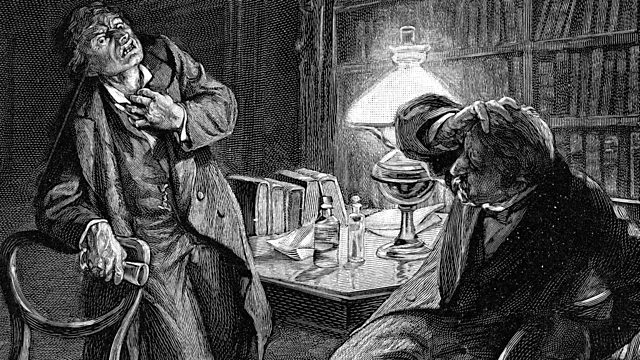
The heart of Lanyon’s narrative lies in his firsthand account of Hyde’s transformation into Jekyll. This moment not only reveals the shocking truth but also shatters Lanyon’s worldview, marking a climactic point in the novel.
Descriptive Language and Gothic Imagery
Stevenson spares no detail in describing Hyde’s transformation. Through vivid imagery, he captures both the physical and psychological horror of the scene.
- Key Quote:
“He reeled, staggered, clutched at the table and held on, staring with injected eyes, gasping with open mouth.”
The use of dynamic verbs (“reeled,” “staggered”) and auditory imagery (“gasping”) creates a sense of chaos and terror. Hyde’s actions are almost inhuman, reinforcing his role as the monstrous “other.”
The Power of the Supernatural
For Lanyon, this moment transcends (i.e. goes beyond) scientific understanding. Stevenson juxtaposes Lanyon’s scientific scepticism with the supernatural horror of the transformation, symbolising the limitations of rational thought.
How This Links to the Novel:
This scene is the ultimate payoff for the mystery Stevenson has been building throughout the story. It also ties directly into the theme of duality, as Lanyon’s rational mind is confronted with the horrifying union of Jekyll and Hyde within a single body.
Lanyon’s Reaction: Horror Meets Fatal Curiosity
The narrative concludes with Lanyon’s complete emotional and physical collapse. His reaction is key to understanding the destructive power of Jekyll’s experiments.
The Psychological Toll of Forbidden Knowledge
Lanyon’s breakdown shows the cost of uncovering the truth.
- Key Quote:
“My life is shaken to its roots.”
Stevenson uses metaphorical language to show how deeply Lanyon is affected. His rational, scientific identity is “shaken,” leaving him unable to reconcile what he has seen.
The Gothic Consequences of Overreaching
Lanyon’s death shortly after this revelation aligns with Gothic conventions (context), where characters who seek forbidden knowledge are often doomed.
How This Links to the Novel:
Lanyon’s reaction mirrors Jekyll’s eventual fate, showing how the pursuit of knowledge and power can lead to self-destruction. This also reflects the Victorian fear of crossing moral and scientific boundaries.
Themes and Literary Devices in Dr. Lanyon’s Narrative
By now, it should be clear that Lanyon’s narrative is rich with themes and Gothic tropes.
Let’s recap some of the key elements:
- Secrecy and Repression: Mirrors Jekyll’s hidden desires and Hyde’s concealed existence.
- Science vs. Supernatural: Highlights the limitations of Victorian science.
- Duality: Lanyon’s inability to reconcile Jekyll and Hyde’s identities reflects the central theme of the novel.
- Gothic Imagery: Words like “staggered” and “blasted” evoke fear and the uncanny.
So, how could you put all this into practice?
Here is a bank of Jekyll and Hyde exam questions, grouped by character. Take a look at the Lanyon character question (alongside the accompanying mark scheme) and have a go at writing the essay for yourself.
I’ll add my own sample essay response at a later date. Let me know if you’d find this helpful!
10 Key Quotes About Dr. Lanyon (with Language Points)
To round things off, here’s a useful bank of 10 key quotes for analysing Dr. Lanyon — complete with quick notes on language, themes, and context. These are great to revise, memorise, or weave into your own exam responses. They follow Lanyon’s character arc from confident rationalist to a man shattered by the truth he uncovers.
What would you add to this list?
1. “He began to go wrong, wrong in the mind.”
Lanyon’s repetition of “wrong” suggests growing frustration and disbelief. It’s a dismissive judgement, rooted in his rational worldview — a sign of how far Jekyll’s work has drifted from traditional science.
2. “Unscientific balderdash.”
Blunt and scathing, this phrase sums up Lanyon’s no-nonsense attitude. The alliteration gives it a punchy tone, reflecting how strongly he rejects anything mystical or irrational — a key theme in the novel’s science vs. supernatural debate.
3. “Hearty, healthy, dapper, red-faced gentleman.”
This triadic list paints Lanyon as warm and physically vigorous — a contrast to Jekyll’s increasingly pale and sickly appearance. Stevenson uses physical description to symbolise characters’ moral and psychological states.
4. “The doctor seemed seized with a qualm of faintness; he shut his mouth tight and nodded.”
Lanyon’s visceral reaction to Hyde shows the instinctive horror Hyde provokes. The passive structure (“was seized”) reinforces his helplessness, and “qualm of faintness” hints at a deep, almost unconscious moral revulsion.
5. “I saw what I saw, I heard what I heard, and my soul sickened at it.”
The parallel phrasing adds rhythm and emotional intensity. The verb “sickened” links the psychological to the physical, and the mention of the “soul” suggests that what he witnessed goes beyond science — into the spiritual and existential.
6. “O God! I screamed, and ‘O God!’ again and again.”
Lanyon’s repetition and religious exclamation emphasise the depth of his horror. The breakdown of formal language into panic reflects Gothic conventions — and the idea that some knowledge is too terrible to bear.
7. “My life is shaken to its roots.”
A powerful metaphor. Stevenson uses “shaken” and “roots” to suggest something fundamental has been disturbed — Lanyon’s entire belief system. It reflects the novel’s wider anxiety about the stability of scientific and moral knowledge.
8. “I shall never recover.”
Short, declarative and hopeless. This simple sentence shows Lanyon has given up — he has no tools, emotional or scientific, to process what he’s seen. It’s a key moment of Gothic despair.
9. “I want to see or hear no more of Dr. Jekyll.”
This rejection is both personal and ideological. It marks the end of Lanyon’s friendship and shows how Jekyll’s actions have crossed a moral boundary. The repetition of “no more” suggests finality and disgust.
10. “The deadliest terror sits by me at all hours of the day and night.”
Here, Stevenson uses personification to show how Lanyon’s fear is constant and inescapable. The Gothic imagery — “deadliest terror” — suggests a living, haunting presence, reinforcing how the knowledge he gained is destroying him.
These quotes are perfect for building detailed, high-level responses to essay questions on Lanyon, science vs. supernatural, and Gothic horror. Try picking three or four and zooming in on how Stevenson’s language choices reflect the novel’s themes and context.
In Summary: Why Dr. Lanyon’s Narrative is Essential
Dr. Lanyon’s narrative is more than just a dramatic revelation—it’s a microcosm of the novel’s themes and a showcase of Stevenson’s Gothic storytelling. By analyzing this chapter, you’ll not only unpick the mystery of Jekyll and Hyde but also develop the skills to write insightful essays that connect language, themes, and context.
For more help with GCSE English Literature and Language (including creative writing and detailed guidance on exam questions, essay structure and more), I offer expert tuition tailored to your needs. Get in touch today, and let’s make Jekyll and Hyde less daunting—and more enjoyable!
Support my work
Have you found this post helpful? By contributing any amount, you help me create free study materials for students around the country. Thank you!
 AC studies